Asser International Sports Law Blog

Our International Sports Law Diary
The Asser International Sports Law Centre is part of the T.M.C. Asser Instituut

Olympic Agenda 2020: Window Dressing or New Beginning?

Shortly after his election as IOC President, Thomas Bach announced his intention to initiate an introspective reflection and reform cycle dubbed (probably a reference to former German Chancellor Gerhard Schröder’s publicly praised Agenda 2010) the Olympic Agenda 2020. The showdown of a year of intense brainstorming is to take place in the beginning of December 2014 during an IOC extraordinary session, in which fundamental reforms are expected. More...

The French collective agreement for professional Rugby tackled by Kelsen’s Pyramid - Guest Post by Patrick Millot

Pursuant to Kelsen’s famous pyramid, the authority of norms may be ranked according to their sources: Constitution is above the Law, which is in turn superior to the Regulations, which themselves stand higher to the Collective Agreement etc…Under French labour law, this ranking can however be challenged by a “principle of favourable treatment” which allows a norm from a lower rank to validly derogate from a superior norm, if (and only if) this derogation benefits to the workers.

On 2 April 2014, the Cour de Cassation (the French Highest Civil Court) considered that these principles apply in all fields of labour law, regardless of the specificity of sport[1].  In this case, Mr. Orene Ai’i, a professional rugby player, had signed on 13 July  2007 an employment contract with the Rugby Club Toulonnais (RCT) for two sport seasons with effect on 1 July 2007. More...

UEFA may have won a battle, but it has not won the legal war over FFP

Yesterday, the press revealed that the European Commission decided to reject the complaint filed by Jean-Louis Dupont, the former lawyer of Bosman, on behalf of a player agent Striani, against the UEFA Financial Fair Play (FFP) Regulations. The rejection as such is not a surprise. The Commission had repeatedly expressed support of the principles underlying the UEFA FFP. While these statements were drafted vaguely and with enough heavy caveats to protect the Commission from prejudicing a proper legal assessment, the withdrawal of its support would have been politically embarrassing.

Contrary to what is now widely assumed, this decision does not entail that UEFA FFP regulations are compatible with EU Competition Law. UEFA is clearly the big victor, but the legal reality is more complicated as it looks. More...


The Nine FFP Settlement Agreements: UEFA did not go the full nine yards

The UEFA Club Licensing and Financial Fair Play Regulations have been implemented by UEFA since the season 2011/12 with the aim of encouraging responsible spending by clubs for the long-term benefit of football. However, the enforcement of the break-even requirement as defined in Articles 62 and 63 of the Regulations (arguably the most important rules of FFP) has only started this year. Furthermore, UEFA introduced recently amendments to the Procedural rules governing the Club Financial Control Body (CFCB) allowing settlement agreements to be made between the clubs and the CFCB.  

On Friday 16 May, UEFA finally published the nine separate settlement agreements between the respective clubs and the CFCB regarding the non-compliance with the Financial Fair Play (FFP) break-even requirements. More...

Dahmane v KRC Genk: Bosman 2.0 or Storm in a Teacup?

Mohamed Dahmane is a professional football player of French-Algerian origin, who has played for a variety of European clubs, including French club US Mauberge, Belgian club RAEC Mons and Turkish club Bucaspor. However, he will mostly be remembered as the player whose legal dispute with his former club (Belgian club KRC Genk) revived the debate on football players’ labour rights.  More...

Get Up, Stand Up at the Olympics. A review of the IOC's policy towards political statements by Athletes. By Frédérique Faut

The Olympic Games are a universal moment of celebration of sporting excellence. But, attention is also quickly drawn to their dark side, such as environmental issues, human rights breaches and poor living conditions of people living near the Olympic sites. In comparison, however, little commentary space is devoted to the views of athletes, the people making the Olympics. This article tries to remediate this, by focussing on Rule 50 of the Olympic Charter which prevents athletes from freely expressing their (political) thoughts.  More...

Final Report on the FIFA Governance Reform Project: The Past and Future of FIFA’s Good Governance Gap

Qatar’s successful bid to host the 2022 World Cup left many people thunderstruck: How can a country with a population of 2 million people and with absolutely no football tradition host the biggest football event in the world? Furthermore, how on earth can players and fans alike survive when the temperature is expected to exceed 50 °C during the month (June) the tournament is supposed to take place?

Other people were less surprised when FIFA’s President, Sepp Blatter, pulled the piece of paper with the word “Qatar” out of the envelope on 2 December 2010. This was just the latest move by a sporting body that was reinforcing a reputation of being over-conservative, corrupt, prone to conflict-of-interest and convinced of being above any Law, be it national or international.More...

Asser International Sports Law Blog |

Asser International Sports Law Blog

Our International Sports Law Diary
The Asser International Sports Law Centre is part of the T.M.C. Asser Instituut

The CAS jurisprudence on match-fixing in football: What can we learn from the Turkish cases? - Part 2: The procedural aspects. By Thalia Diathesopoulou

With this blog post, we continue the blog series on Turkish match-fixing cases and our attempt to map the still unchartered waters of the CAS’s match-fixing jurisprudence.

The first blog post addressed two issues related to the substance of match-fixing disputes, namely the legal characterization of the match-fixing related measure of ineligibility under Article 2.08 of the UEL Regulations as administrative or disciplinary measure and the scope of application of Article 2.08. In addition, The Turkish cases have raised procedural and evidentiary issues that need to be dealt with in the framework of match-fixing disputes.

The CAS panels have drawn a clear line between substantial and procedural matters. In this light, the Eskişehirspor panel declared the nature of Article 2.08 UEL Regulations to be administrative and rejected the application of UEFA Disciplinary Regulations to the substance. Nonetheless, it upheld that disciplinary rules and standards still apply to the procedure. This conclusion, however, can be considered puzzling in that disciplinary rules apply to the procedural matters arising by a pure administrative measure. To this extent, and despite the bifurcation of different applicable rules into substantial and procedural matters, the credibility of the qualification of Article 2.08 as administrative seems to be undermined. And here a question arises: How can the application of rules of different nature to substantial and procedural matters in an identical match-fixing dispute be explained?More...

The EU State aid and Sport Saga – A blockade to Florentino Perez’ latest “galactic” ambitions (part 2)

This is the second part of a blog series on the Real Madrid State aid case. In the previous blog on this case, an outline of all the relevant facts was provided and I analysed the first criterion of Article 107(1) TFEU, namely the criterion that an advantage must be conferred upon the recipient for the measure to be considered State aid. Having determined that Real Madrid has indeed benefited from the land transactions, the alleged aid measure has to be scrutinized under the other criteria of Article 107(1): the measure must be granted by a Member State or through State resources; the aid granted must be selective; and it must distorts or threatens to distort competition. In continuation, this blog will also analyze whether the alleged aid measure could be justified and declared compatible with EU law under Article 107(3) TFEU.More...

The CAS jurisprudence on match-fixing in football: What can we learn from the Turkish cases? - Part 1 - By Thalia Diathesopoulou

The editor’s note:

Two weeks ago we received the unpublished CAS award rendered in the Eskişehirspor case and decided to comment on it. In this post Thalia Diathesopoulou (Intern at the ASSER International Sports Law Centre) analyses the legal steps followed and interpretations adopted by CAS panels in this case and in a series of other Turkish match-fixing cases. The first part of the post will deal with the question of the legal nature of the ineligibility decision opposed by UEFA to clubs involved in one way or another into match-fixing and with the personal and material scope of UEFA’s rule on which this ineligibility is based. The second part is dedicated to the procedural rules applied in match-fixing cases.


Introduction

The unpredictability of the outcome is a sine qua non feature of sports. It is this inherent uncertainty that draws the line between sports and entertainment and triggers the interest of spectators, broadcasters and sponsors. Thus, match-fixing by jeopardising the integrity and unpredictability of sporting outcomes has been described, along with doping, as one of the major threats to modern sport.[1] More...


Sport and EU Competition Law: uncharted territories - (I) The Swedish Bodybuilding case. By Ben Van Rompuy

The European Commission’s competition decisions in the area of sport, which set out broad principles regarding the interface between sports-related activities and EU competition law, are widely publicized. As a result of the decentralization of EU competition law enforcement, however, enforcement activity has largely shifted to the national level. Since 2004, national competition authorities (NCAs) and national courts are empowered to fully apply the EU competition rules on anti-competitive agreements (Article 101 TFEU) and abuse of a dominant position (Article 102 TFEU).

Even though NCAs have addressed a series of interesting competition cases (notably dealing with the regulatory aspects of sport) during the last ten years, the academic literature has largely overlooked these developments. This is unfortunate since all stakeholders (sports organisations, clubs, practitioners, etc.) increasingly need to learn from pressing issues arising in national cases and enforcement decisions. In a series of blog posts we will explore these unknown territories of the application of EU competition law to sport.More...

The Legia Warszawa case: The ‘Draconian’ effect of the forfeiture sanction in the light of the proportionality principle. By Thalia Diathesopoulou

The CAS denial of the urgent request for provisional measures filed by the Legia Warszawa SA in the course of its appeal against the UEFA Appeals Body Decision of 13 August 2014 put a premature end to Legia’s participation in the play-offs of the UEFA Champion’s League (CL) 2014/2015. Legia’s fans- and fans of Polish football - will now have to wait at least one more year to watch a Polish team playing in the CL group stage for the first time since 1996. More...

The EU State aid and Sport Saga – A blockade to Florentino Perez’ latest “galactic” ambitions (part 1)

This is the first part of a blog series involving the Real Madrid State aid case.

Apart from being favoured by many of Spain’s most important politicians, there have always been suspicions surrounding the world’s richest football club regarding possible financial aid by the Madrid City Council. Indeed, in the late 90’s a terrain qualification change by the Madrid City Council proved to be tremendously favourable to the king’s club. The change allowed Real Madrid to sell its old training grounds for a huge sum. Though the exact price for the grounds remains unknown, Real Madrid was suddenly capable of buying players like Figo and Zidane for record fees. However, the European Commission, even though agreeing that an advantage was conferred to the club, simply stated that the new qualification of the terrain in question does not appear to involve any transfer of resources by the State and could therefore not be regarded as State aid within the meaning of article 107 TFEU.

Agreements between the club and the Council have been a regularity for the last 25 years.  A more recent example concerns an agreement signed on 29 July 2011 (Convenio29-07-2011.pdf (8MB). More...

UEFA Financial Fair Play Regulations Put PSG and Manchester City on a Transfer Diet

The main lesson of this year’s transfer window is that UEFA’s Financial Fair Play (FFP) rules have a true bite (no pun intended). Surely, the transfer fees have reached usual highs with Suarez’s move to FC Barcelona and Rodriguez’s transfer from AS Monaco to Real Madrid and overall spending are roughly equal to 2013 (or go beyond as in the UK). But clubs sanctioned under the FFP rules (prominently PSG and Manchester City) have seemingly complied with the settlements reached with UEFA capping their transfer spending and wages. More...

Right to Privacy 1:0 Whereabouts Requirement - A Case Note on a Recent Decision by the Spanish Audiencia Nacional

On the 24th June 2014 the Spanish Audiencia Nacional issued its ruling on a hotly debated sports law topic: The whereabouts requirements imposed to athletes in the fight against doping. This blog aims to go beyond the existing commentaries (here and here) of the case, by putting it in the wider context of a discussion on the legality of the whereabouts requirements. More...

The Rules of the Electoral Game for the FIFA 2015 Presidential Elections

After the success of this year’s World Cup in Brazil, FIFA President Sepp Blatter can start concentrating on his Presidential campaign for next June’s FIFA elections. Even though the 78-year old Swiss is not officially a candidate yet, he is still very popular in large parts of the world, and therefore the favourite to win the race. Nonetheless, even for the highly experienced Mr. Blatter these elections will be different. All candidates will have to respect the newly introduced Electoral Regulations for the FIFA PresidencyMore...

Can (national or EU) public policy stop CAS awards? By Marco van der Harst (LL.M, PhD Candidate and researcher at the AISLC)

Introduction[1]

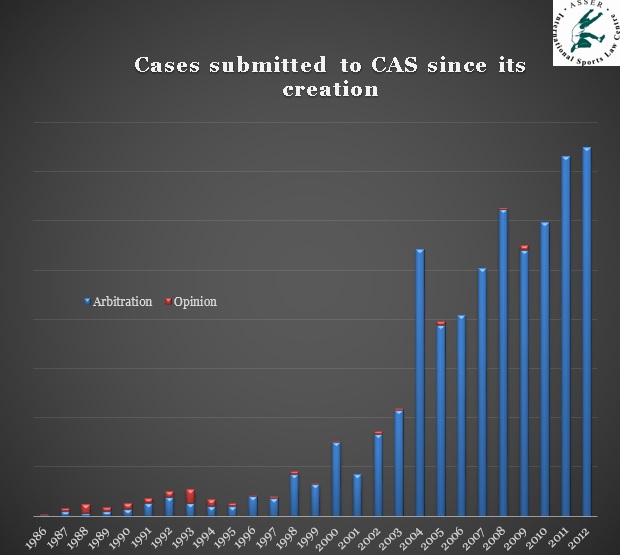
The Court of Arbitration for Sport (CAS) registers approximately 300 cases every year. Recently, the Swiss Federal Supreme Court – which is the sole judicial authority to review arbitral awards rendered in Switzerland – reminded in the Matuzalém Case (Case 4A_558/2011) that CAS awards may be enforced in other States that are parties to the New York Convention on the recognition and enforcement of foreign arbitral awards.More...